Infrastructure
A detailed review of the infrastructures we have in the projects at the tr3e Thermo-chemical REnewable Energy & Environment research group of the University Carlos III of Madrid (UC3M)
Thermochemical Conversion Laboratory
Modular Fixed-Bed Gasification Platform
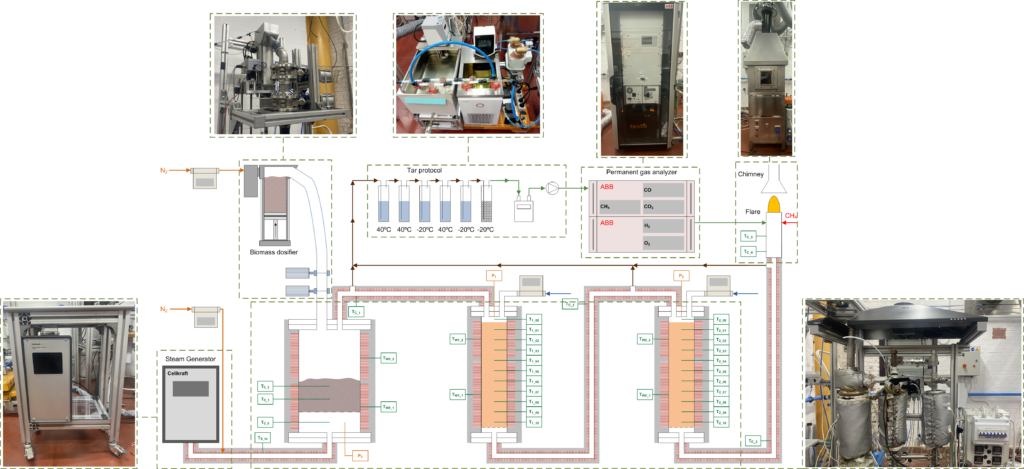
Our modular fixed-bed gasification platform has been designed to investigate biomass thermochemical conversion under highly controlled and flexible operating conditions. The system integrates a primary fixed-bed gasifier with two interchangeable downstream reactors, enabling the evaluation of different gas upgrading and reforming strategies within the same experimental campaign.
The installation incorporates a high-precision biomass feeding system based on a piston-driven mechanism combined with controlled vibrations, ensuring a stable and continuous particle-by-particle biomass supply. This design provides accurate control of the fuel feeding rate, minimizing flow fluctuations and improving the repeatability of gasification experiments.
Steam is supplied by a dedicated steam generation unit, allowing precise control of the steam-to-biomass ratio and enabling studies under steam gasification and steam reforming conditions.
Downstream of the gasifier, the modular reactor section consists of the primary gasification reactor followed by two secondary reactors that can be operated independently or in series. This flexible configuration makes it possible to investigate catalytic upgrading, tar reforming, gas conditioning, and multi-stage thermochemical processes using different reactor designs and operating conditions.
Tar sampling is performed using a Tar Protocol system compliant with internationally accepted methodologies. The setup includes two thermostatically controlled baths operating at 40 °C and −20 °C, enabling efficient condensation and collection of condensable hydrocarbons for subsequent quantitative and qualitative analysis. In addition, the facility incorporates multiple gas sampling ports distributed along the reactor, allowing Solid Phase Adsorption (SPA) measurements at different axial locations. This capability enables spatial characterization of tar composition and concentration, providing valuable insight into tar formation, cracking, and reforming mechanisms within the reactor.
Product gas composition is comprehensively characterized using an online permanent gas analyser, providing continuous real-time measurements of H₂, CO, CO₂, CH₄, and O₂, together with a micro gas chromatograph (micro-GC) for the quantitative analysis of light hydrocarbons (C₂ and C₃ species). This combination enables detailed monitoring of process stability, reaction dynamics, and syngas composition throughout each experimental campaign.
Finally, all produced gas is safely directed to a dedicated flare system, where combustible gases are completely oxidized before being discharged through the laboratory chimney, ensuring safe operation while complying with laboratory safety and environmental requirements.
The combination of precise fuel feeding, flexible reactor configuration, controlled steam injection, comprehensive online gas analysis, standardized tar sampling, spatially resolved tar characterization, and safe gas handling makes this facility a versatile research platform for developing and validating advanced biomass gasification and syngas upgrading technologies.
Modular Bubbling Fluidized-Bed Gasification Platform
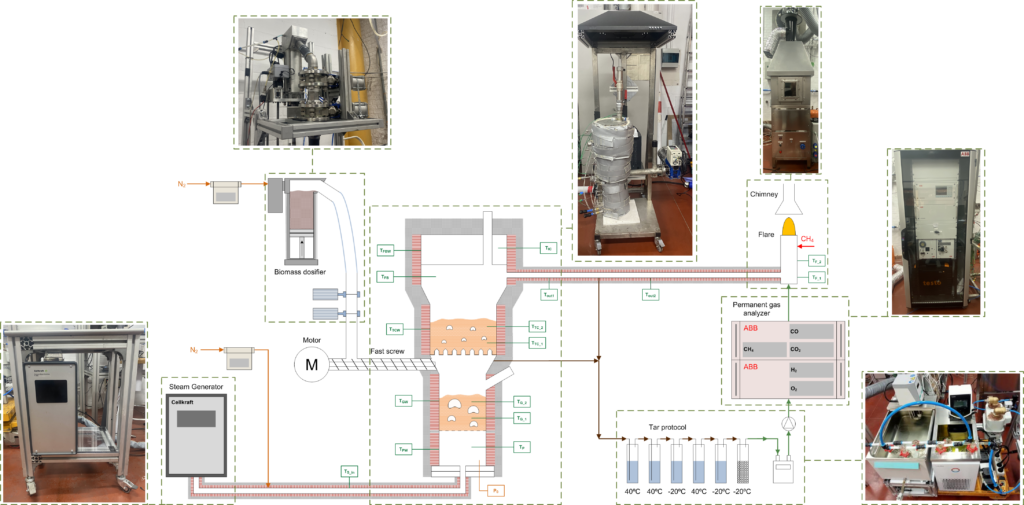
This modular bubbling fluidized-bed gasification platform has been designed to investigate biomass thermochemical conversion under highly controlled and flexible operating conditions. The facility can be configured either as a conventional bubbling fluidized-bed gasifier or with an integrated top fluidized-bed reactor for in-bed tar cleaning, allowing direct comparison between conventional gasification and advanced gas upgrading within the same experimental setup.
Fuel is supplied through a high-precision biomass feeding system based on a piston-driven mechanism combined with controlled vibrations, delivering biomass continuously and particle by particle. This feeding technology provides excellent control of the biomass flow rate while ensuring stable reactor operation and highly reproducible experiments.
Steam is generated by a dedicated steam generation unit, enabling precise control of the steam flow and the steam-to-biomass ratio over a wide range of gasification conditions.
The heart of the facility is the modular reactor assembly, consisting of a bubbling fluidized-bed gasifier with an optional secondary fluidized-bed reactor positioned above the gasification zone. The upper reactor can be filled with different bed materials to promote in-bed tar cracking and syngas upgrading, offering exceptional flexibility for investigating novel reactor configurations and gas cleaning strategies.
The platform is extensively instrumented for hydrodynamic characterization. High-frequency Kistler pressure sensors continuously measure pressure fluctuations throughout the reactor, providing detailed information on fluidization quality, bubble dynamics, bed stability, and overall reactor hydrodynamics under different operating conditions.
Tar sampling is performed using a Tar Protocol system based on internationally accepted methodologies. The sampling train incorporates thermostatically controlled baths maintained at 40 °C and −20 °C, enabling efficient condensation and collection of tar compounds for subsequent quantitative and qualitative analysis. In addition, the facility incorporates multiple gas sampling ports distributed along the reactor, allowing Solid Phase Adsorption (SPA) measurements at different axial locations. This capability enables spatial characterization of tar composition and concentration, providing valuable insight into tar formation, cracking, and reforming mechanisms within the gasifier and the integrated tar-cleaning reactor.
Syngas composition is comprehensively characterized using an online permanent gas analyser, providing continuous real-time measurements of H₂, CO, CO₂, CH₄, and O₂, together with a micro gas chromatograph (micro-GC) for the quantitative analysis of light hydrocarbons (C₂ and C₃ species). This combination enables detailed monitoring of gasification performance, process stability, and syngas composition throughout each experimental campaign.
For safe operation, all product gas is directed to a dedicated flare system, where combustible gases are completely oxidized before being discharged through the laboratory chimney.
The combination of modular reactor design, precise biomass feeding, controlled steam injection, advanced hydrodynamic instrumentation, standardized tar sampling, spatially resolved tar characterization, comprehensive online gas analysis, and safe gas handling makes this facility a versatile platform for fundamental studies and the development of advanced biomass gasification technologies.
Particle-Level Thermochemical Reactor
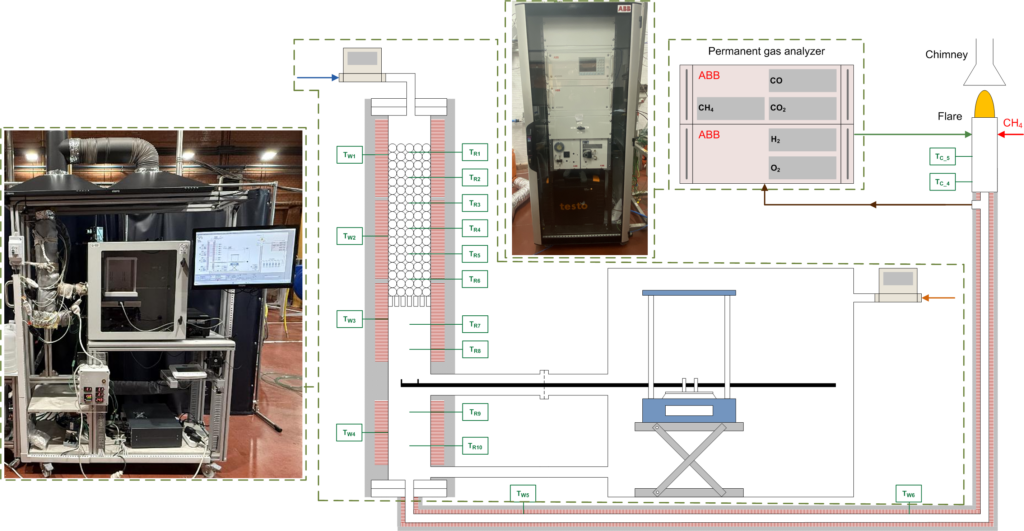
The particle-level thermochemical reactor has been developed to investigate the conversion behaviour of individual particles under well-defined and highly controlled operating conditions. By combining high-resolution gravimetric measurements with precise thermal control and flexible gas atmospheres, the system provides detailed insight into the fundamental mechanisms governing thermochemical conversion.
At the heart of the facility is a high-precision microbalance capable of supporting one or several particles while continuously measuring their mass with excellent temporal and mass resolution. This enables the real-time determination of mass loss or gain throughout the conversion process, allowing detailed kinetic and mechanistic studies at the particle scale.
The reactor is equipped with four independently controlled electrical heating zones, providing excellent temperature uniformity and precise thermal management during experiments. Multiple thermocouples distributed along the reactor continuously monitor the temperature profile, ensuring accurate control of the thermal environment.
The installation can operate under a wide variety of reactive atmospheres, including inert, reducing, oxidizing, steam-containing, and corrosive environments. This versatility makes the system suitable for investigating a broad range of thermochemical processes, including biomass and waste pyrolysis, gasification, combustion, calcium looping carbonation/calcination cycles, and oxidation–reduction reactions of chemical looping materials and metal oxide cycles.
The reactor can be coupled to an online permanent gas analyser, providing continuous measurements of H₂, CO, CO₂, CH₄, and O₂ during the experiment. Combining gas composition with high-resolution mass evolution allows simultaneous characterization of solid conversion and gas production in real time.
For safe operation during experiments involving combustible gases, the outlet stream can be connected to a dedicated flare system, where the product gases are completely oxidized before being discharged through the laboratory chimney.
The combination of precise gravimetric analysis, advanced temperature control, flexible gas atmospheres, online gas analysis, and safe gas handling makes this facility a powerful platform for studying thermochemical conversion mechanisms, reaction kinetics, and particle-scale phenomena across a wide range of energy and environmental applications.
Experimental Platform for Advanced Thermal Management
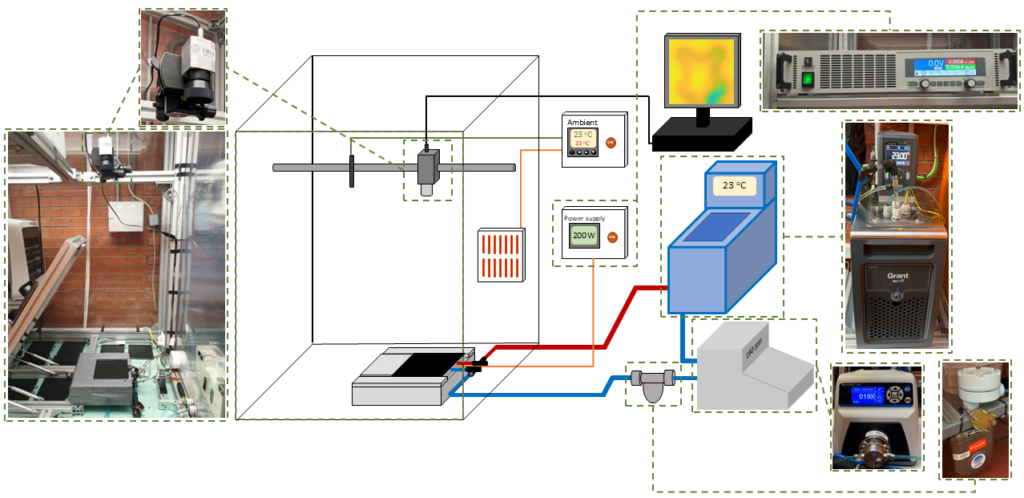
The Experimental Platform for Advanced Thermal Management has been developed to experimentally investigate heat transfer enhancement and coolant flow distribution in advanced cooling systems for high-heat-flux applications. The facility provides a highly controlled environment for evaluating innovative thermal management concepts and validating numerical models under steady-state operating conditions.
The platform accommodates interchangeable cooling devices manufactured by conventional or additive manufacturing techniques, enabling direct comparison between different channel geometries, flow distribution strategies, and cooling architectures. A modular hydraulic circuit supplies coolant at accurately controlled temperature and flow rate, allowing experiments over a wide range of operating conditions.
A thermostatic bath maintains a constant coolant inlet temperature, while a gear pump delivers stable flow through the test section. The mass flow rate is continuously measured using a Coriolis flowmeter, and high-precision resistance temperature detectors (RTDs) monitor the inlet and outlet coolant temperatures, providing accurate determination of the thermal performance of each configuration.
A flexible electrical heater applies a uniform and well-defined heat flux to the test specimen, reproducing the thermal loads encountered in practical thermal management applications. Heat losses are minimized through dedicated insulation, ensuring highly repeatable experiments and reliable energy balances.
The temperature distribution over the test surface is measured using a high-resolution infrared camera, enabling full-field thermal characterization with sub-millimetre spatial resolution. Time-averaged thermal maps are obtained under steady-state conditions, providing detailed information on temperature uniformity, local hot spots, and cooling effectiveness.
The combination of controlled hydraulic operation, precise thermal instrumentation, infrared thermography, and modular test sections makes this facility a powerful experimental platform for investigating advanced thermal management technologies for fuel cells, batteries, power electronics, data centres, and other high-performance thermal systems. It is particularly well suited for validating numerical simulations and optimizing innovative cooling solutions based on advanced flow distribution concepts.
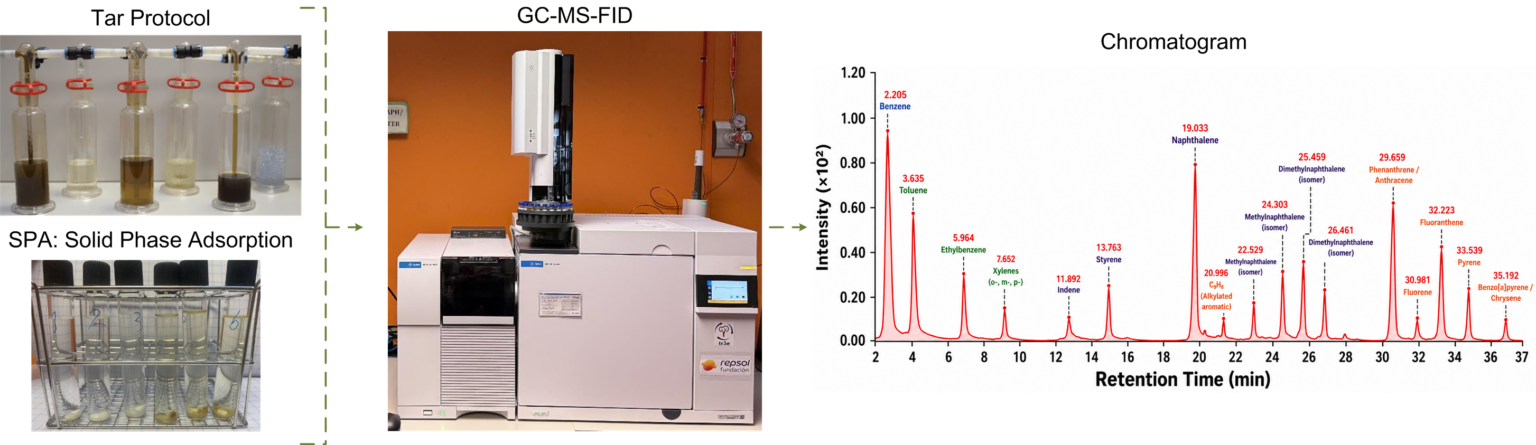
GC–MS/FID Platform for Tar and Liquid Fuel Characterization
Our analytical platform is centred on an Agilent 8860 Gas Chromatograph coupled to an Agilent 5977C Mass Selective Detector (MSD) and a Flame Ionization Detector (FID), equipped with an Agilent J&W HP-5 capillary column. This versatile configuration combines the molecular identification capabilities of mass spectrometry with the high sensitivity and quantitative performance of flame ionization detection, providing detailed characterization of complex organic mixtures.
The system is primarily dedicated to the analysis of gasification tars produced during thermochemical conversion experiments. Tar samples can be collected using a Tar Protocol system based on internationally accepted methodologies or captured through Solid Phase Adsorption (SPA), allowing the characterization of compounds ranging from light aromatic hydrocarbons to heavy polycyclic aromatic hydrocarbons (PAHs).
Mass spectral identification is performed using the 5977C quadrupole mass spectrometer, while the FID enables accurate quantification of target compounds. The combination of both detectors provides reliable qualitative and quantitative analysis of complex tar mixtures, supporting studies on tar formation, cracking, catalytic reforming, and gas cleaning technologies. The instrument operates under the Agilent Mass Hunter platform, enabling automated data acquisition, spectral matching, and compound quantification.
Beyond tar characterization, the platform is also employed for the analysis of renewable liquid fuels and bio-based products, including bio-oils, pyrolysis liquids, upgraded biofuels, hydrotreated vegetable oils (HVO), biodiesel, and other renewable fuel blends. The system enables detailed compositional analysis, identification of individual compounds, and evaluation of fuel quality through chromatographic profiling.
The combination of advanced chromatographic separation, mass spectrometric identification, flame ionization quantification, and versatile sample preparation techniques makes this facility a powerful analytical platform for investigating thermochemical conversion processes and the composition of renewable fuels.
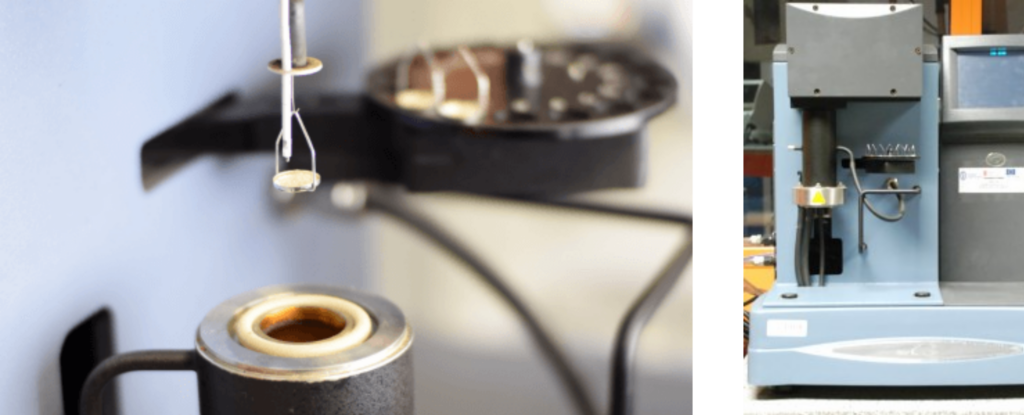
BIOLAB - Biofuels Characterization Laboratory
Thermogravimetric Analyser – TGA Q500 from TA Instruments
High-performance thermogravimetric analyser capable of measuring mass changes with a sensitivity of 0.1 μg from ambient temperature up to 1000 °C, enabling precise characterization of thermal stability, decomposition, and reaction kinetics.
Used to determine proximate analysis, pyrolysis, combustion and gasification behaviour, reaction kinetics, and the thermal conversion of biomass, wastes, biochars, catalysts, and other energy-related materials.
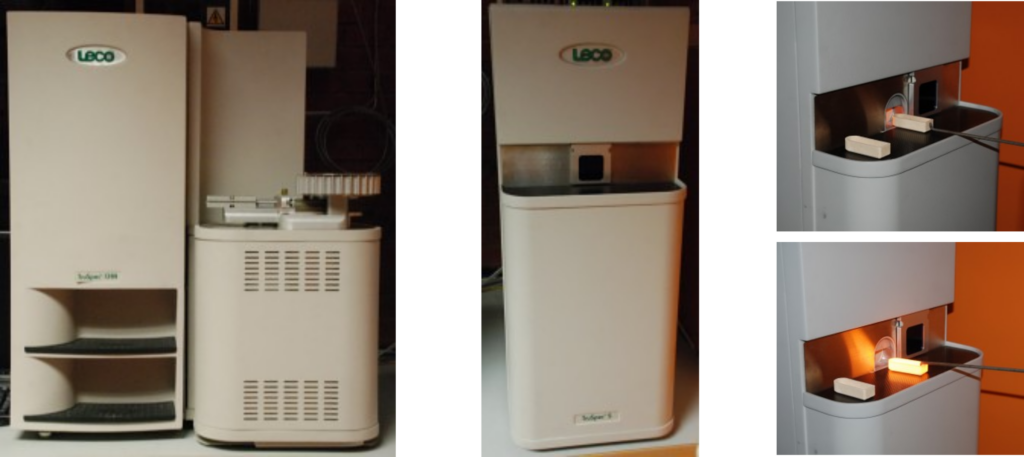
Elemental Analyser – LECO TruSpec CHN-S
Automatic elemental analyser based on the Dumas combustion method for the accurate determination of carbon, hydrogen, nitrogen, and sulfur in solid samples, providing rapid and highly reproducible measurements.
Used to determine the elemental composition of biomass, biochars, wastes, renewable fuels, and solid residues, providing essential data for fuel characterization and thermochemical process evaluation.
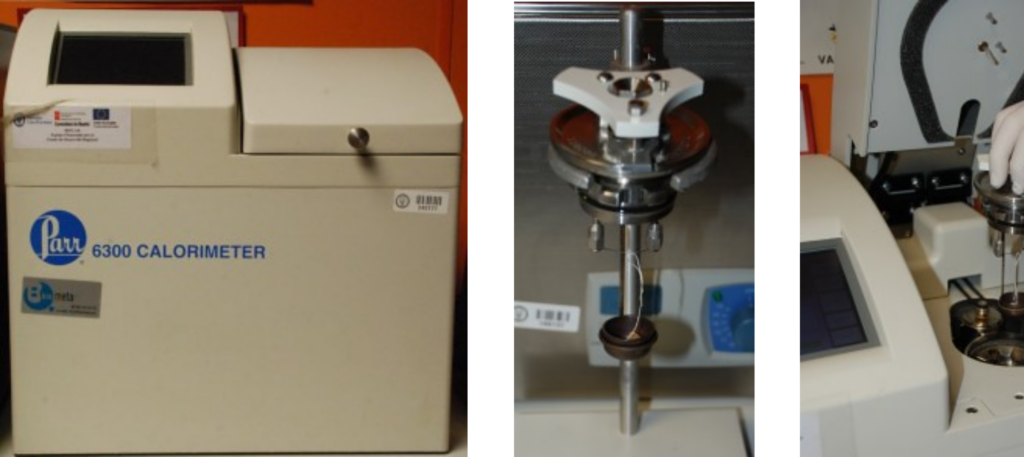
Isoperibolic Calorimeter – Parr 6300
Automatic isoperibolic oxygen bomb calorimeter designed for the accurate determination of the higher heating value (HHV) of solid and liquid fuels, with a precision better than 0.1%.
Used to measure the energy content of biomass, waste-derived fuels, chars, biofuels, renewable fuels, and other combustible materials for fuel characterization and energy balance calculations.
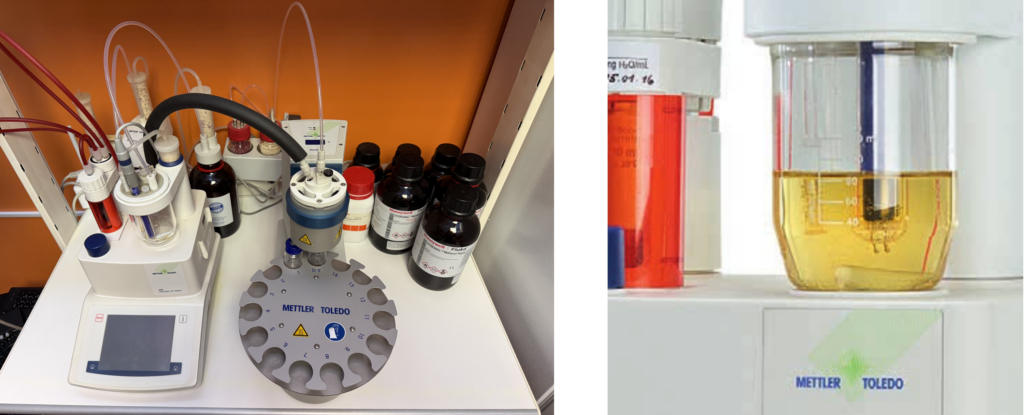
Karl Fischer Titrator – Mettler Toledo V30
Automatic volumetric Karl Fischer titration system for the accurate determination of water content in liquids and soluble solids, providing reliable moisture analysis over a wide concentration range.
Used to determine the moisture content of liquid biofuels, renewable fuels, organic solvents, tar samples, and other chemicals where precise water quantification is essential for analytical characterization and process evaluation.
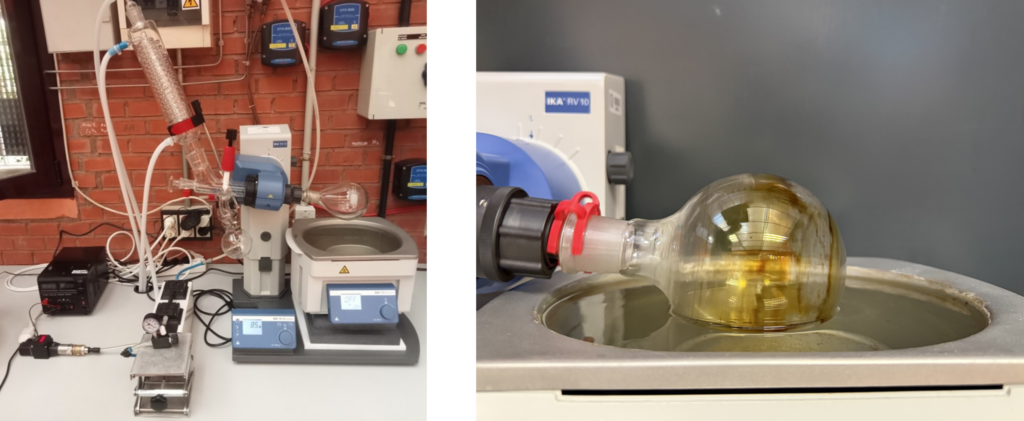
Rotary Evaporator – IKA RV 10 with Vacuum Pump
Laboratory rotary evaporator equipped with controlled vacuum operation for the efficient removal and recovery of solvents under reduced pressure, minimizing thermal degradation of heat-sensitive compounds.
Used for sample concentration, solvent exchange, and preparation of liquid samples prior to chromatographic analysis. It is also routinely employed for the gravimetric determination of tar content in producer gas samples following standard tar sampling procedures.
High-Performance Computational Cluster
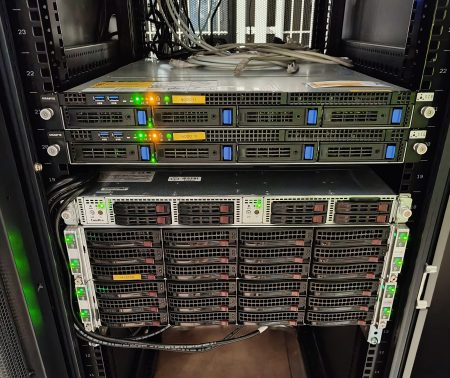
Dedicated high-performance computing (HPC) cluster comprising 11 compute nodes with 20, 36, and 40-core processors, providing a total of 412 CPU cores for parallel numerical simulations. The system includes a master node with 16 TB of storage, 80 GB SSD per compute node, and 128 GB DDR4 RAM per node, enabling efficient execution of computationally demanding models.
The cluster supports advanced numerical simulations across multiple spatial scales, from particle-scale and pore-scale phenomena to reactor-scale and process-scale modelling. It is routinely used for CFD simulations, heat and mass transfer analyses, thermochemical conversion modelling, optimization studies, and the development of digital tools for renewable energy and environmental applications.